

Foreign visitors can pay for most daily purchases in China by linking an international card to both Alipay and WeChat Pay. Bring RMB cash as the immediate fallback; in Shanghai, use a contactless bank card to tap directly through the metro gates. If you are moving long term, open a mainland RMB account for rent, personal transfers and recurring payments.
Note
The practical stack: two mobile wallets, two linked cards if possible, a physical contactless card and ¥500–1,000 in mixed RMB notes. Add a mainland bank account only when your life in China starts involving rent, salary, personal transfers or regular bills.
This is not another list of apps to download. It is a checkout guide: what to use at a restaurant, a metro gate, a rental signing, an online store or a utility counter—and what to do when the first method fails. For the wider setup sequence, including maps, transport and delivery apps, see The China apps foreigners actually need in 2026.
What should you set up before flying?
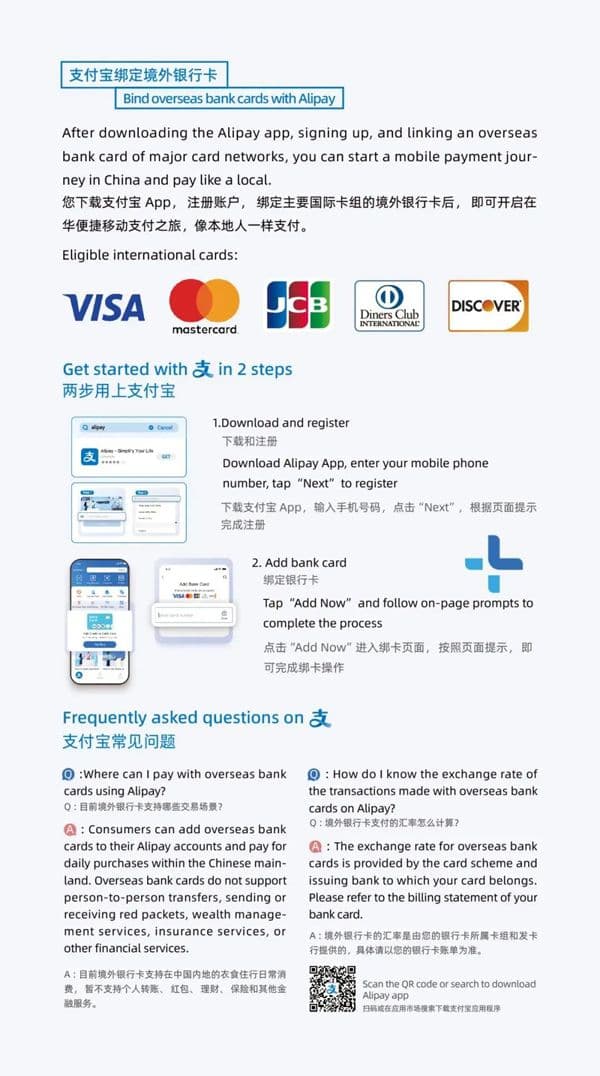
Install both Alipay and WeChat, complete the identity checks shown in each app and link an international card before departure. Both accept overseas phone numbers and supported overseas cards. Doing this at home gives you time to resolve passport-name mismatches, card-verification messages and issuing-bank blocks before you need to pay for something.
Check five things:
- the passport name, wallet identity and cardholder name match;
- the linked card appears as an available payment method;
- your bank permits overseas and online transactions;
- you know the bank's foreign-transaction fee and exchange-rate markup; and
- you can still receive verification messages after landing.
Set up a second card if you have one. A wallet problem and a card-issuer problem are different failure points, so having two wallets connected to the same single card is not a complete backup.
Should you use Alipay or WeChat Pay?
Use both. Alipay is often the easier newcomer interface for transport, shared bikes, ride-hailing and other daily services. WeChat Pay is useful when a restaurant, merchant or mini-program already lives inside WeChat.
You do not need to choose a permanent winner. At an ordinary checkout, use whichever wallet the merchant supports and keep the other as the first fallback.
The distinction that matters is not Alipay versus WeChat. It is merchant checkout versus personal transfer. An overseas card linked to a wallet is designed primarily for purchases from supported merchants. A personal QR code, person-to-person transfer or some mini-program checkouts can fail even when the same card worked at a supermarket five minutes earlier.
What are the current fees and limits?
Shanghai's official payment guide, updated on 24 July 2026, states that an international card linked to Alipay or Weixin Pay can be used for up to US$5,000 in a single transaction and US$50,000 per year. Those are wallet limits, not a promise that every merchant, card issuer or transaction type will work.
For Weixin Pay, a payment of ¥200 or less using an international card is normally exempt from the 3% service fee. Tencent also announced that first-time international-card users receive a 90-consecutive-day fee waiver on daily spending up to ¥1,000. Treat that as an account-level offer: rely on it only when it appears in your own app or payment confirmation.
Your issuing bank can still apply a foreign-transaction fee or its own exchange rate when the wallet charges no service fee. Before confirming a larger payment, look at the amount and fee shown on screen rather than assuming the small-payment rule applies.
Which method works in each situation?
| Situation | Start with | What must already work | Immediate fallback |
|---|---|---|---|
| Restaurant, café or shop | Alipay or WeChat merchant checkout | Verified wallet + linked card | Other wallet, other card, then RMB cash |
| Shanghai metro | Contactless international card tapped at the gate | Eligible card + contactless enabled | Single ticket, transport QR or physical transport card |
| Bus or ferry | Shanghai public-transport QR | Activated transport code | Physical transport card; ask staff if cash is accepted |
| Online shopping or delivery | Platform checkout | Wallet, phone number and Chinese delivery address | Buy in person; local bank card for long-term use |
| Water, electricity or gas | Alipay or WeChat Utilities | Correct utility account number | Property office, service outlet, post office, bank or participating store |
| Rent or deposit | Landlord's verified bank account or written payment channel | Signed contract + confirmed account name | Bank-counter transfer after verification |
| School or other large fee | Institution's official payment instructions | Invoice or written account details | Confirm directly with its finance office |
| International inward transfer | Receiving bank's written remittance instructions | Exact beneficiary, account, branch and SWIFT/BIC details | Ask the receiving branch before sending |
How do you pay in restaurants, shops and cafés?
At a normal merchant, scan its QR code or show your payment code for the cashier to scan. Before confirming, check the merchant name and amount on your screen.
If a linked international card fails:
- switch to the other wallet;
- choose a different linked card;
- ask for the business's official merchant checkout rather than an individual's QR code; and
- pay cash if you need to finish the purchase immediately.
International hotels, airports and some larger retailers accept overseas physical cards directly. Many ordinary businesses still expect Alipay, WeChat Pay, UnionPay or cash, so an overseas plastic card should not be your only daily fallback.
Can you tap an international card on the Shanghai metro?
Yes. Since 28 June 2025, Shanghai Metro has allowed eligible contactless UnionPay, Visa, Mastercard, American Express and JCB cards to tap directly at gates across the full network. You do not need to activate a metro QR code first.
Enable contactless and small-value password-free payment with your issuing bank before travelling. The same physical card must be used to tap in and out. A fee or exchange-rate markup can still be charged by the card issuer, and not every card implementation is technically eligible.
This direct tap rule is specifically useful for the metro. Do not assume the same overseas card works directly on every Shanghai bus or ferry. For those, activate the Shanghai public-transport QR in a supported app or use a physical Shanghai Public Transportation Card.

If the gate rejects your card, buy a single ticket or ask station staff for help. Solve the bank or wallet problem after the journey rather than repeatedly tapping and blocking the queue.
How does online shopping and food delivery work?
Use the payment method shown at the platform checkout. A linked international card may work when the purchase is processed by a supported merchant, but that does not mean every marketplace seller, mini-program or delivery checkout accepts it.
Payment is only one part of the setup. You also need:
- a phone number the platform can verify;
- a complete delivery address, preferably saved in Chinese;
- a local contact number for the courier; and
- access to platform messages when delivery needs clarification.
For a short visit, hotel delivery or buying in person can be easier than resolving a one-off platform failure. For a long-term move, a mainland number and locally funded bank account make ordinary e-commerce more reliable.
At a restaurant, a table QR may open a mini-program that rejects your linked card. Ask staff to take the order and let you pay through the restaurant's normal merchant code. Do not mistake one failed mini-program for proof that your entire wallet is broken.
How do you pay water, electricity and gas bills?
If the utility account is in your name—or the landlord gives you the correct account number—use Utilities in Alipay or Me → Services → Utilities in WeChat. Choose Shanghai, select the provider, enter the account number and confirm the customer or property details before paying.
Shanghai's official resident guide also lists offline payment through property offices, utility service outlets, post offices, banks and participating convenience stores. Ask the landlord or property manager who is responsible for each bill before adding an account. Paying the wrong unit's bill is a harder problem than choosing the wrong wallet.
How should you pay rent, deposits and other large amounts?
Do not treat a rental signing like a restaurant checkout. Verify the contract and the recipient before moving money.
Before paying, confirm that:
- the recipient account belongs to the landlord or the party identified in the signed agreement;
- the amount and purpose match the contract;
- the bank name, account number and recipient name were not changed only through a chat message;
- any agency fee is documented separately; and
- you will receive a receipt or other proof of payment.
A landlord may accept a bank transfer, while some serviced apartments or institutions provide an official merchant channel. A linked international card is not guaranteed to support a personal QR transfer, and a wallet's published transaction ceiling does not make an unverified account safe.
For the contract, ownership, deposit, agency-fee and restricted-compound checks that should happen before payment, read Renting in Shanghai: what to verify before you pay.
When should you open a Chinese bank account?
A tourist or short business visitor usually does not need one. A long-term resident should try early because a locally funded RMB account makes personal transfers, rent, recurring bills, online shopping and salary payments more dependable.
Shanghai's published baseline is a valid passport or Foreign Permanent Resident ID Card plus a real-name mainland Chinese mobile number. A branch may also request employment or admission documents, a tax identification number, proof of address or a Declaration of Personal Tax Residency Status. Requirements can vary by bank, branch, visa and purpose.
For a long-term move, activate a mainland number and try the bank during the first few working days. Bring more supporting material than the stated minimum: passport, employment or university documents, tax number and address evidence. If an employer pays your salary or a university pays a stipend, ask whether it expects a particular bank. For the complete document checklist, branch choice and same-day setup checks, read our guide to opening a bank account in Shanghai.
How do you transfer money from overseas into China?
Mainland Chinese bank accounts do not use IBAN. Do not add “CN” to an account number or try to convert it into an IBAN. China is not listed as a registered national IBAN format in Swift's current registry.
Before an international wire or telegraphic transfer, ask the receiving Chinese bank for written, currency-specific inward-remittance instructions. The sender will normally need:
- the beneficiary's exact name as held by the bank;
- the full Chinese account or card number;
- the receiving bank and branch;
- the bank's SWIFT/BIC code;
- the beneficiary's phone number and address; and
- any intermediary-bank or payment-purpose information requested for that currency.
Supporting documents may be required for foreign-exchange compliance, and intermediary banks may deduct charges. Swift identifies the bank and carries transfer instructions; it is not an IBAN substitute. Confirm the currency, fees, exchange rate and expected documents with both banks before sending a large amount.
Should you carry cash or use e-CNY?
Keep roughly ¥500–1,000 in mixed RMB notes during your first days. Cash covers a failed identity check, blocked card, dead phone, personal QR code your international card cannot fund, or taxi ride when the app fails. Exchange money through a qualified counter or withdraw RMB at an ATM displaying your card network, subject to issuer fees.
Cash is the fallback, not the main system. Keep it in more than one place and avoid relying on a single large note that a small merchant may struggle to change.
The e-CNY app is another official option, but it is not essential for most newcomers. Shanghai's current guide says an international user can register with an overseas phone number, top up a wallet using Visa or Mastercard and return unused wallet funds to the linked card. It can be useful as another payment rail, but it does not replace the merchant coverage and daily-life integrations of Alipay and WeChat.
What should you do when a payment fails?
Use this sequence:
- check the merchant name and amount;
- switch wallets;
- select another linked card;
- ask for the merchant's official checkout rather than a personal QR code;
- use RMB cash for the immediate purchase; and
- inspect wallet and issuing-bank messages before trying again.
Repeated attempts can trigger another fraud check. If the wallet asks for identity verification, complete it inside the app. Do not send passport images to a merchant, agent or stranger who says they can “unlock” the payment.
When is the foreign-card setup enough?
Alipay and WeChat Pay linked to international cards are enough for most restaurants, shops, metro trips and short-visit spending. They are not a complete resident banking system.
If you are staying long term, receiving salary, paying rent, shopping regularly online or sending money to individuals, open a mainland account when your documents allow it. If you are visiting for a few days, do not spend half the trip building a resident setup you will not use.
For accommodation registration, mobile service, banking, permits and the order in which to tackle them, use Your first 30 days in Shanghai, in order. The complete moving-to-Shanghai guide shows where payment setup fits into the wider move.
Common questions
Paying in China: common questions
Can foreigners use Alipay and WeChat Pay in China?
Yes. International users can register with an overseas phone number and link supported international cards. Complete the identity and card checks before flying, then use supported merchant checkouts in China.
Do I need a Chinese bank account to use Alipay or WeChat Pay?
No. A supported international card is enough for many ordinary merchant purchases. A mainland account becomes useful for long-term residents who need personal transfers, rent, recurring bills, online shopping or salary payments.
Can I use an overseas credit card everywhere in China?
No. Some hotels, airports and larger retailers accept one directly, but many ordinary merchants rely on Alipay, WeChat Pay, UnionPay or cash. Link the card to both wallets before arrival.
Can I tap my Visa or Mastercard on the Shanghai metro?
Eligible contactless Visa, Mastercard, American Express, JCB and UnionPay cards can tap directly at Shanghai Metro gates. Enable contactless payment, use the same card to enter and exit, and keep a single ticket or transport card as backup.
Can I pay rent in China with a foreign card?
Do not assume so. A landlord may request a bank transfer or personal payment route that a linked international card cannot fund. Verify the contract and recipient, then obtain written payment instructions before sending a deposit or rent.
Do Chinese bank accounts have an IBAN?
No. An international wire normally uses the beneficiary's ordinary Chinese account number together with the receiving bank, branch and SWIFT/BIC instructions.
How much cash should I bring?
If both wallets are working, you do not need much. Keeping roughly ¥500–1,000 in mixed RMB notes during the first days gives you a fallback for phone, card, wallet and merchant-checkout failures.
Sources & last verified (17 August 2026):
- Mobile payments, international-card limits, cash, e-CNY and RMB accounts — People's Bank of China Shanghai Head Office via International Services Shanghai: english.shanghai.gov.cn
- Alipay registration and overseas-card setup — International Services Shanghai: english.shanghai.gov.cn
- Weixin Pay's 90-day first-user international-card fee waiver — Tencent: tencent.com
- Weixin Pay's ¥200 small-payment fee rule — Tenpay: posts.tenpay.com
- Direct international contactless-card access across Shanghai Metro — International Services Shanghai: english.shanghai.gov.cn
- Utility payment methods and offline service channels — International Services Shanghai: english.shanghai.gov.cn
- Documents and tax-residency declaration for a Shanghai bank account — International Services Shanghai: english.shanghai.gov.cn
- Registered national IBAN formats, Release 102, June 2026 — Swift: swift.com
- Chinese-account and SWIFT details for inward remittance — ICBC: icbc.com.cn
Keep reading
- GuideThe China Apps Foreigners Actually Need in 2026Set up China travel apps before you fly: WeChat, Alipay, Amap, Trip.com, eSIM/VPN, AI translation, 12306 and Shanghai resident tools.
- GuideYour first 30 days in Shanghai, in orderA practical Shanghai arrival hub for employees, students, families and short stays: what to prepare, what to do first and where each route splits.
- GuideMoving to Shanghai in 2026: The Complete GuidePlanning a move to Shanghai in 2026? An honest, no-commission guide to the decisions that matter before you come — cost, the right order, schools, visas, and daily life.
helloChina weekly
Get the weekly Shanghai intel
One email a week — visa changes, housing, international schools and culture. Timely, practical, no fluff.