
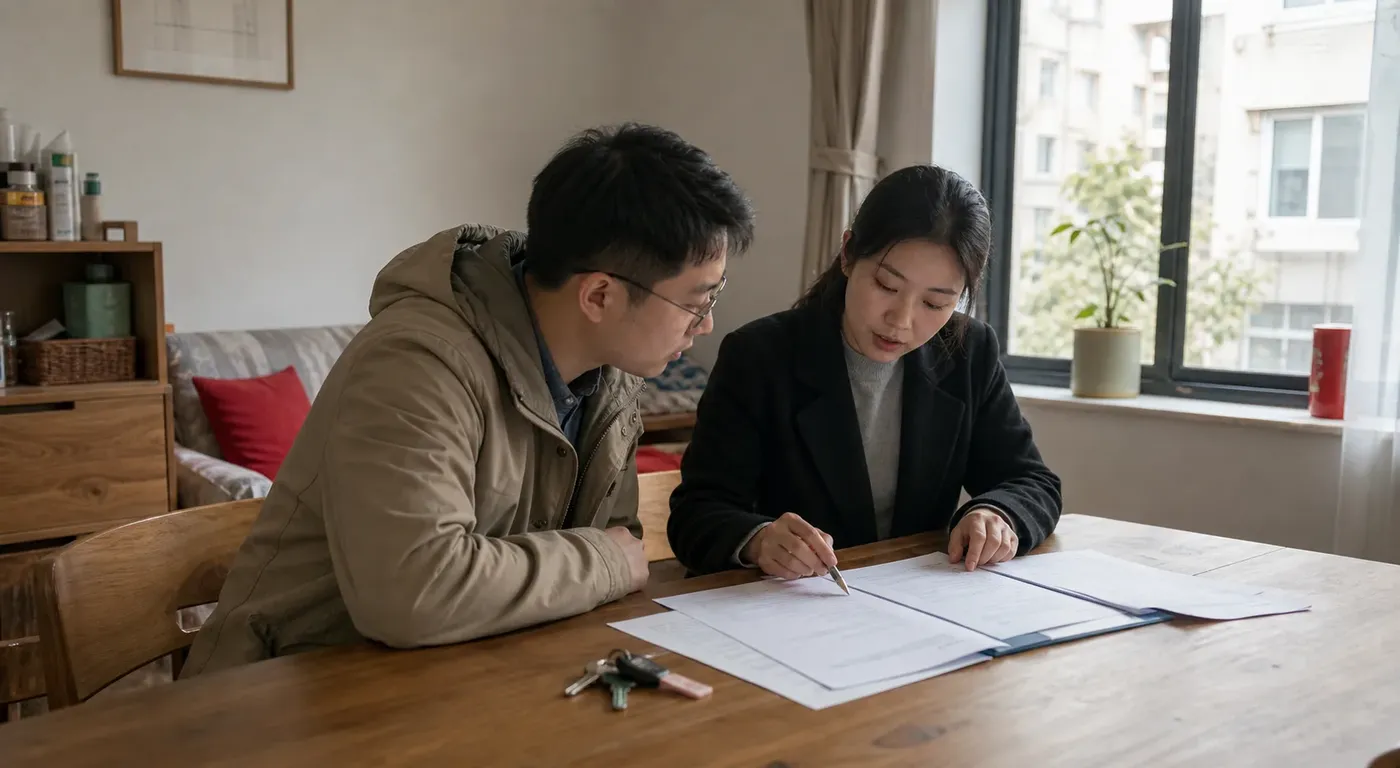
Before you transfer any money for a Shanghai apartment, verify five things: the listing and agent, the person's legal right to rent the home, the property's real condition, the contract terms, and the payment route. Only then should you sign, pay, complete the lease filing and register the address after moving in.
When I review a Shanghai rental, I do not ask whether the apartment or agent feels trustworthy. I ask whether every name, document and payment connects. Who owns the home? If someone else is signing, where does their authority come from? Does the contract describe the same address and furniture you inspected? Does the bank account belong to the party legally receiving the money?
A mismatch is not always fraud. A legitimate sublet or professionally managed apartment may involve several parties. But until the chain makes sense on paper, it is a reason to pause.
Watch out
A reservation payment does not make an unverified apartment safer. Before paying one, get the exact property, recipient, purpose, refund conditions and treatment of the money in writing. If you cannot verify the right to rent the home, do not transfer the money.
What should I verify before paying for an apartment?
Use five gates. Do not skip a gate because the unit is attractive, another viewer is supposedly waiting, or the agent says the paperwork can be fixed later.
| Gate | Evidence to collect | Proceed when | Pause or walk away when |
|---|---|---|---|
| 1. Listing and agent | Housing verification code; agency and agent details; written fee list | The listing, agent and institution can be checked and the information is consistent | Photos, address, price or agent identity keep changing; fees stay verbal |
| 2. Right to rent | Owner ID and ownership record, or a clear authority/sublet/management chain | The signer can prove ownership or another lawful right to rent the property | Nobody will show the ownership or authority documents |
| 3. Property condition | In-person or live inspection; written condition statement; dated photos; compound notices | Defects, furniture, promised repairs and the right to rent to an outsider are clear | Important damage is kept out of writing, or a military/government-affiliated compound displays a no-external-rental notice |
| 4. Contract and payment | Complete signed lease; deposit and fee terms; named recipient and account | The contract, invoice/receipt trail and payment recipient all match | You are asked to pay an agent personally or transfer before the lease and refund terms are complete |
| 5. Handover and registration | Handover record; meter readings; keys; filing plan; accommodation-registration plan | Responsibilities and deadlines are assigned before move-in | The address supposedly cannot be filed or registered, but you are told not to worry |
These are not five different services. They are one transaction trail. If a dispute happens, that trail is what shows what you rented, from whom, on which terms and for how much.
How do I verify a Shanghai rental listing and agent?
Ask for the 房源核验码 (fángyuán héyànmǎ — housing verification code) and check it on the Shanghai Housing Rental Public Service Platform. A verified listing receives a code that is normally valid for 60 days; it expires after the period ends, after online signing and filing, or if the home becomes restricted from rental.
No code shown in the first conversation does not automatically prove a scam. A direct owner may not have completed the process yet. It does mean you should pause until the owner, property and legal right to rent are verified another way. "I will show you after you pay" is not another way.
Shanghai uses real-name management for rental-agency staff. For a normal transaction, make sure the contract shows the agency's full company name and official seal, plus the name, contact number and signature of the agent handling your rental. Those details should match the person and company you actually dealt with.
The current national Regulation on Housing Leasing, effective since September 15, 2025, also requires a housing rental agency to do more than send photos. Before publishing a property, it must check the client's identity and ownership information, inspect the home, sign an agency service contract and prepare a stamped statement of the property's condition.
Ask for the practical results of that work:
- Who instructed the agency to market the home?
- What ownership or lawful-rental document was checked?
- Has the agent inspected this exact unit?
- What does the stamped condition statement disclose?
- What services are included in the agency fee?
- Which additional services, if any, cost extra?
Agency fees are negotiated; Shanghai does not have a statutory tenant percentage that applies to every channel and price band. Current national guidance requires services and prices to be displayed separately and a fee list to be confirmed before payment. Get the payer, amount, timing and refund treatment in writing.
In the Shanghai transactions I see, the usual structure is half a month's rent from the landlord and half a month's rent from the tenant. Some agencies charge only the landlord, so the tenant pays no agency fee. If a standard rental agent asks you, as the tenant, for more than half a month's rent, I would walk away. That is a current market and risk judgement, verified in August 2026, not a legal tariff.
What if the person signing is not the owner?
The name on the lease does not always have to be the name printed on the ownership certificate. It does have to connect to a lawful right to rent the property.
Start with the 不动产权证书 (bùdòngchǎn quánzhèngshū — real property ownership certificate) or another ownership document accepted by Shanghai's filing rules. Compare the address and unit number with the apartment you viewed. Then identify which of these structures you are dealing with:
The owner is signing directly
Compare the owner's identity document with the ownership record and lease. If the home is jointly owned or another person's rights are involved, ask what consent or signing arrangement is required rather than accepting an oral assurance.
An authorised representative is signing
Ask for the written authorisation, the owner's identity and ownership evidence, and the representative's identity. The authorisation should cover the acts being performed, especially signing and receiving money.
A tenant is subletting
The colloquial term is 二房东 (èr fángdōng — second landlord or sublessor). A sublet can be legitimate. Under the Civil Code, a tenant may sublet with the landlord's consent; an unauthorised sublet can give the landlord a right to terminate the head lease.
For a safe decision, ask for the head lease, the remaining term and clear evidence of the owner's consent. The sublease should not promise a term or right the head tenant does not have. Do not rely on "the owner knows" when written confirmation is available.
A housing rental company is the lessor
A rental company may operate a home it does not own because it has obtained management or subletting rights. Check the company registration and filing, the company name and seal on the contract, its authority over the exact unit, and the account it instructs you to use.
The question is therefore not "Does every name match?" It is: Can every difference be explained by a document that reaches back to the owner or another lawful source of rental authority?
What should I inspect in the apartment itself?
Verify the condition before negotiating the final contract, then repeat the important checks at handover. Listing photos are not evidence of what works on move-in day.
At minimum, test and record:
- water pressure, hot water and drainage;
- air-conditioning and heating functions in each relevant room;
- signs of damp, mould or recent cosmetic covering;
- signs of termites or recent termite treatment, especially around timber floors, door frames and built-in cabinets;
- old or current rainwater leaks around the roof, exterior walls and windows;
- windows, locks, access cards and door security;
- gas, electrical outlets and visible safety concerns;
- appliances included in the lease;
- noise with the windows both open and closed;
- mobile signal and the practical internet-installation route;
- furniture, storage and any item the owner plans to remove;
- existing scratches, stains, broken fittings and wall damage.
For an older home in central Shanghai, ask the agent or owner two direct questions: Has the home had termite prevention or treatment? Has it leaked during the spring and early-summer rainy season, especially the 梅雨季 (méiyǔjì — plum-rain season)? Ask where the problem occurred, what was repaired and when. If possible, view after rain. Put any promised 白蚁防治 (báiyǐ fángzhì — termite treatment) or waterproofing repair into the signed condition attachment with a completion deadline.
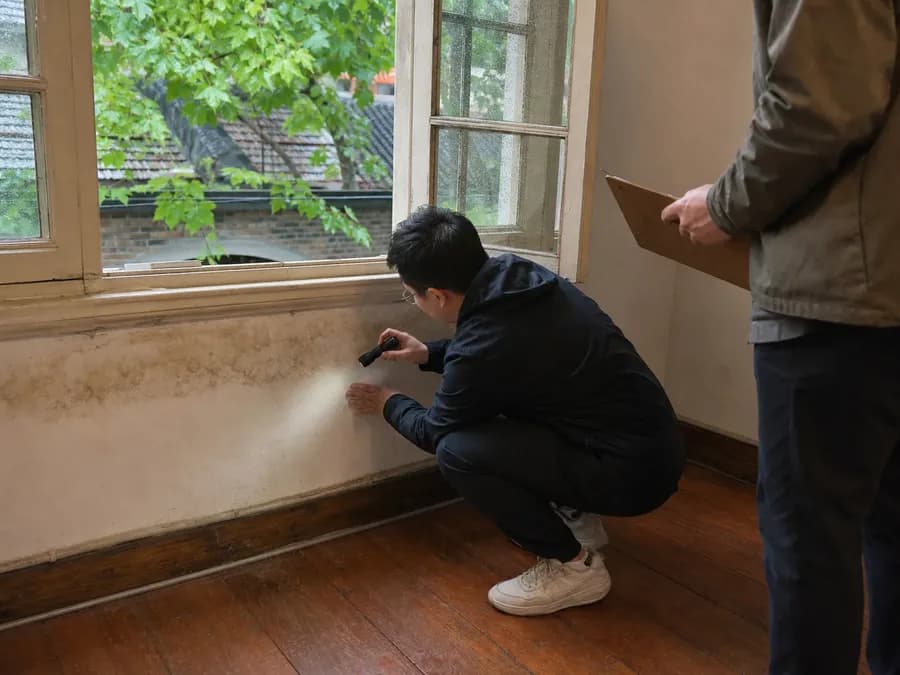
For an older central Shanghai home, ask about termite treatment and rainy-season leaks before signing—not after the first storm.
Also read the notices at the compound entrance and on the exterior walls. Some Shanghai military compounds (部队小区, bùduì xiǎoqū) and government- or public-institution-affiliated compounds (政府/机关小区, zhèngfǔ / jīguān xiǎoqū) explicitly prohibit homes from being rented to outsiders. The restriction is normally stated on a visible sign. This does not mean every military- or government-linked compound is restricted; the decision turns on the notice and management rules for that exact property.
Important
Do not rent a home in a military or government-affiliated compound when the entrance, exterior wall or management area displays a notice prohibiting external rentals. A good environment or unusually low rent does not compensate for the risk. If the unauthorised tenancy is discovered, you can be required to leave immediately, and recovering rent, deposit or compensation may be difficult because the transaction ignored the compound's restriction.
Shanghai's rental rules require institutions and agencies to disclose in writing factors that may affect use and safe occupation. Even in a direct-owner deal, put defects and promised repairs into a signed attachment. A WeChat promise to "fix it next week" is much harder to enforce than a repair item with a responsible party and deadline in the lease or handover record.
Use dated photos or video, but do not collect more personal information than the transaction requires. The goal is a record of the property, meters and contents, not a documentary about the landlord.
Which clauses matter most in a Shanghai lease?
The Shanghai Housing Leasing Regulations list the core subjects a residential lease should cover: the parties and co-occupants, the home and facilities, use and repair responsibilities, term and delivery, rent and deposit, utilities and property charges, breach, and dispute resolution.
The practical test is not whether those headings appear. It is whether the wording answers the next question when something goes wrong.
| Subject | The lease should answer | Weak wording to avoid |
|---|---|---|
| Deposit (押金 yājīn) | Amount; holder; return deadline; permitted deductions; evidence required; treatment after early exit | "Returned after deductions" with no deadline or deduction rules |
| Rent | Amount; payment dates; cadence; currency; recipient; account; late-payment process | Payment instructions sent later only by chat |
| Other costs | Whether quoted rent includes property management; responsibility for water, electricity, gas, internet, parking, repairs and invoice-related costs | "Tenant pays all costs" without categories |
| Repairs | Owner and tenant responsibilities; response time; emergency process; reimbursement evidence | "Minor repairs by tenant" with no definition or limit |
| Early exit | Notice; qualifying events; compensation; deposit treatment; replacement tenant; handover | A verbal promise that "we can discuss it later" |
| Owner access | Notice and permitted reasons for entry, except a genuine legal emergency | Unrestricted access whenever the owner wants |
| Inventory and condition | Furniture list; existing damage; meter readings; promised work; handover standard | No signed attachment or dated record |
| Language | Complete text understood and signed by both parties; which version prevails if versions conflict | An English summary beside a different Chinese contract |
| Filing and registration | Who completes lease filing, by when, and which documents each party supplies | "This address cannot be registered" after payment |
Deposit terms are contractual, not a slogan
The national regulation requires the lease to state the deposit amount, return time and permitted deductions. It does not create a universal one-month legal cap for every private Shanghai landlord.
Shanghai has narrower protections for specific structures. If a housing rental enterprise takes more than three months' rent at once or more than one month's rent as a deposit, the excess covered by the rule must enter its supervised rental-funds account. Government-supported rental housing has its own one-month deposit cap. Neither rule should be quoted as a blanket cap for every private lease.
In my experience, one month's deposit with monthly or quarterly rent is a sensible position to ask for because it limits the money at risk. But "sensible" and "legally mandatory" are different claims. If the owner asks for more, judge the total exposure, the authority chain, the contract and your alternatives together.
Repair responsibility needs a process
The Civil Code places the repair duty on the lessor unless the parties agree otherwise. It also provides a route for the tenant to request repairs and, if the lessor fails to act within a reasonable period, to arrange repairs with the cost borne by the lessor; use interrupted by repairs may support a rent reduction or longer term. Damage caused by the tenant is different.
Do not turn that legal baseline into a plan to repair first and argue later. Put the notification channel, response period, emergency threshold, approval process and evidence for reimbursement in the contract.
There is no universal one-month early-exit penalty
Shanghai leases often use a deposit or an agreed sum when a tenant leaves early, but the law does not set one universal month of compensation for every case. Write the notice period, compensation, qualifying events and handover requirements directly into the lease.
A "diplomatic clause" may be familiar from another expat market, but the label itself does not protect you. The actual Chinese and English wording does.
Who should receive the rent and deposit?
The payment route should follow the legal relationship in the contract.
- Owner-direct lease: normally the named owner or a clearly authorised recipient.
- Authorised representative: only within written authority that covers receiving the relevant payment.
- Housing rental company: the contracting company through its documented account and, where the rules apply, its public supervised-funds account.
- Sublet: the lawful sublessor named in the sublease, after the authority chain has been checked.
A housing rental broker is different from the lessor. Under the national Regulation on Housing Leasing, a broker must not collect or forward rent or deposits for the parties. Online listing platforms are subject to the same prohibition.
If an agent asks you to transfer the deposit to a personal account "to hold the apartment", stop and ask for a compliant route. Do not solve a broken payment chain with a reassuring receipt written by the same person receiving the money.
For every payment, keep:
- the final signed contract and relevant attachment;
- the written payment instruction;
- the account holder and account details;
- the bank or payment record with a useful reference;
- the receipt or invoice required under the deal.
How much should I pay before move-in?
There is no single Shanghai answer. Deposit size, monthly or quarterly rent, agency fee and invoice costs depend on the property and channel. The safe approach is to separate every component before negotiating the total.
In ordinary Shanghai residential leases I see, the quoted rent generally includes the property management fee (物业费, wùyèfèi). Do not leave that as an assumption. Ask whether it is included and state the answer in the lease. Water, electricity and gas are normally paid by the tenant according to use; internet and parking should be listed separately.
| Payment | Ask before signing | Main risk control |
|---|---|---|
| Deposit | How much, who holds it, when it returns, what can be deducted | Put amount, deadline and deductions in the lease |
| Rent in advance | Monthly, quarterly or another cadence; first and later due dates | Limit unnecessary exposure; verify recipient before transfer |
| Agency fee | Who pays, exact amount, included service and refund treatment | Usual tenant side: half a month; some tenants pay zero; walk away if a standard agent asks the tenant for more than half a month |
| Property and utilities | Whether rent includes the management fee; who pays water, electricity, gas, internet and parking | State that management is included when agreed; name every exception instead of accepting "all other costs" |
| Fapiao | Whether an employer requires it; invoice title and type; issuer; authorisation; frequency; deadline; whether rent is tax-inclusive; who bears tax | Agree the complete process before signing; do not rely on a fixed internet tax percentage |
A 发票 (fāpiào — official tax invoice) is primarily a tax and reimbursement question. Shanghai Tax confirms that a property owner can apply digitally to issue a rental invoice; an authorised tenant can also apply during the authorisation period, subject to review. If your employer reimburses housing, ask the employer which invoice and contracting details it needs before you negotiate the lease.
Before signing, write down whether the agreed rent is 含税 (hánshuì — tax-inclusive) or 不含税 (bù hánshuì — tax-exclusive), who bears the tax generated when an invoice is issued, whose name appears on the invoice, and whether it must be issued monthly or for another period. Do not assume that the phrase "the landlord can provide a fapiao" answers any of those questions.
Do not use a fixed online "tax point" as a shortcut. Shanghai's 2026 VAT treatment changed, and the total generated by the tax system can depend on the taxpayer, invoice, rental period and current relief. Confirm the live calculation through the Electronic Tax Bureau or 12366 when it matters to the deal. A rental fapiao is not a visa or accommodation-registration requirement.
What should happen at handover?
Do one final inspection before accepting the home. Put the handover date and time on the record, and have both parties confirm:
- number of keys, access cards and remotes;
- electricity, water and gas meter readings;
- furniture and appliance inventory;
- existing damage and incomplete repairs;
- unpaid property or utility charges, if any;
- responsibility for services that need an account change;
- the condition expected when you return the home.
Then complete two different administrative tasks.
1. Shanghai housing lease filing
住房租赁合同网签备案 (zhùfáng zūlìn hétóng wǎngqiān bèi'àn — online signing and lease filing) records the rental transaction with the housing authority.
In a direct transaction, the parties can use Shanghai's One-Stop portal or Suishenban, or use an offline district rental or community service centre. If a real-estate agency arranged the lease, the agency should handle it. If a housing rental company is the lessor, the company should handle it. Shanghai's current operating rules allow the electronic filing notice to be downloaded through Suishenban.
Shanghai requires the lessor to file within 30 days. The national regulation also states that if the lessor does not file, the tenant may do so. Agree the responsible person and timing before payment rather than discovering later that nobody intends to complete it.
2. Overseas personnel accommodation registration
境外人员住宿登记 (jìngwài rényuán zhùsù dēngjì — overseas personnel accommodation registration) is a separate public-security process. A foreign national staying outside a hotel must register the address within 24 hours after check-in. A move to a new home creates a new accommodation event.
Shanghai provides an official English self-declaration system and public-security service windows. The current Shanghai walkthrough explains the online route and what to do if review fails.
Lease filing is not accommodation registration, and neither is the domestic Chinese residence-card process. Use the correct name when asking the owner or agent for help.
Which Shanghai rental scams and misrepresentations still matter?
Several older Shanghai renter warnings still describe useful failure patterns, but the rule should be updated for today's verification tools rather than copied literally.
- The key-by-courier story: someone asks for a transfer before you have inspected the exact unit, met or live-verified the person with rental authority, signed the lease and tested the keys. Do not pay for promised access later.
- The supposed private landlord who is really an agent or room operator: the label matters because authority, fees and responsibility change. Ask each person to state whether they are the owner, a co-tenant, a sublessor, an agent or an employee of a rental company, then verify that role.
- The disappearing room sublet: an empty room is offered by someone who claims they are about to move in, but they cannot produce a valid head lease and the owner's consent. Verify both before paying.
- The bait-and-switch listing: the photos, room, price, address or furniture change between the advertisement and viewing. Treat the exact unit you inspected—not the advertisement—as the proposed transaction, and walk away if material differences are concealed.
- The illegal divided room: Shanghai rules prohibit renting a kitchen, bathroom, balcony, storage area or other non-residential space as a separate bedroom, and prohibit unlawful group-rental subdivision. A cheap converted room can end in enforcement and removal, not a bargain.
- The deposit dispute prepared in advance: the condition and inventory are left undocumented so old damage can later be charged to you. Use a signed handover record, dated images and meter readings.
A platform listing, brand name or set of keys is never a substitute for verifying authority, the exact property and the written deal.
Which red flags mean I should walk away?
One missing document can sometimes be corrected. A pattern of pressure and unexplained mismatches is different.
I would stop the transaction if:
- nobody will show ownership or lawful rental-authority evidence;
- someone asks for money before you have inspected the exact unit and verified who can rent it;
- a supposed private owner, co-tenant or sublessor changes roles when questioned;
- the signer, property and payment recipient cannot be connected on paper;
- an agent insists on personally collecting the rent or deposit;
- the property address or unit differs across the ownership record, lease and viewing;
- a military or government-affiliated compound displays a notice that homes may not be rented to outsiders;
- the room is an unlawful subdivision or a non-residential space converted for separate occupation;
- the price, fees or refund conditions change after you agree;
- serious defects or promised repairs are deliberately excluded from the signed record;
- you are told the lease cannot be filed or the address cannot be registered, but you should pay anyway;
- you receive only a partial translation and are pressured to sign a different complete contract;
- a large payment is due before the final lease and refund conditions exist.
Urgency is not proof that another tenant exists. A good apartment can be lost while you check it. That is frustrating, but usually cheaper than winning the wrong transaction.
When do I not need a rental advisor?
If you can inspect the home, read and negotiate the complete contract, verify the owner or authority chain, check the agent and listing, and make the filing and registration plan yourself, you may not need us. A straightforward owner-direct lease with clean documents does not become safer because another person sits in the room.
Independent help is most useful when the structure is not straightforward: a remote search, employer reimbursement, subletting, a managed property, conflicting bilingual terms, unusual payment instructions, or expensive repair and early-exit clauses.
If you are still deciding whether to sign a long lease at all, start with serviced apartment versus renting for your first 90 days. If the lease type is decided but the location is not, compare where expat families actually live in Shanghai. For the difference between DIY, a commissioned agent and an independent advisor, read how to choose relocation help. The broader moving to Shanghai guide connects housing with the rest of the move.
Common questions
Shanghai rental checks: common questions
Is one month's deposit the legal maximum in Shanghai?
Not for every private lease. The contract must state the deposit amount, return date and permitted deductions. Specific one-month protections apply to government-supported rental housing, while supervised-account rules cover excess deposits collected by certain rental enterprises. Do not turn those narrower rules into a universal private-landlord cap.
Can a Shanghai rental agent collect my deposit or rent?
A housing rental broker must not collect or forward rent or deposits for the parties under the national Regulation on Housing Leasing. If an agent asks for payment to a personal account, stop and require a lawful payment route tied to the lessor and contract.
What if the person signing the lease is not the owner?
Ask for the document that creates their authority. That may be an owner authorisation, a head lease plus consent to sublet, or a housing rental company's management rights. The names do not have to be identical, but the legal chain must be clear.
What agency details should appear on a Shanghai rental contract?
Check for the agency's full company name and official seal, plus the handling agent's name, contact number and signature. They should match the company and person who handled the transaction.
How much agency fee should a Shanghai tenant pay?
In the Shanghai market I see, the usual structure is half a month's rent from the landlord and half from the tenant. Some agencies charge only the landlord, so the tenant pays nothing. If a standard rental agent asks the tenant for more than half a month's rent, I would walk away. This is current market guidance, not a legal tariff.
Is lease filing the same as the 24-hour accommodation registration?
No. Lease filing records the rental transaction with the housing authority. Accommodation registration records a foreign national's place of stay with public security and is required within 24 hours after checking into a non-hotel address.
Field guidance on the tenant-side agency-fee ceiling, compounds closed to external rentals, and termite or rainy-season checks for older homes reflects helloChina's Shanghai experience, last verified August 2026.
Sources & last verified (August 2026):
- Ownership evidence, deposits, agency duties, payment restrictions and dispute routes — National Administrative Regulations Database: xzfg.moj.gov.cn
- Shanghai lease contents, filing duties, enterprise fund supervision and real-name agency rules — Shanghai Municipal Government: shanghai.gov.cn
- Listing verification codes, validity and public verification steps — Shanghai Housing Rental Public Service Platform: zfzl.fgj.sh.gov.cn
- Subletting, repairs, normal wear and unsafe housing — Civil Code of the People's Republic of China: fgw.sh.gov.cn
- Negotiated agency fees, itemised services and fee disclosure — State Administration for Market Regulation: samr.gov.cn
- Online, offline, agency and rental-company lease-filing routes — Shanghai Municipal Housing Administration: fgj.sh.gov.cn
- Property-owner rental invoice process — Shanghai Municipal Tax Service: shanghai.chinatax.gov.cn
- Authorised-tenant rental invoice process and 2026 residential-rental VAT treatment — Shanghai Municipal Tax Service: authorised-tenant process; 2026 VAT Q&A
- 24-hour accommodation-registration rule and current online process — Shanghai Municipal Government: english.shanghai.gov.cn
Keep reading
- GuideServiced apartment vs renting in Shanghai (2026): the real first-90-days cash-flow decisionHow much cash do you really need to land in Shanghai — and should you bridge with a serviced apartment or rush a 12-month lease? The honest 2026 math.
- GuideWhere expat families actually live in Shanghai (2026): Jing'an, the FFC, Pudong, Hongqiao, Xinjiangwancheng — honest trade-offsAn honest 2026 comparison of the five Shanghai neighborhoods that absorb almost every relocating expat family — Jing'an, the Former French Concession, Pudong (Jinqiao/Lujiazui), Hongqiao/Gubei, and the emerging Xinjiangwancheng. Real rents in a softening market, real commute times to specific schools, and the regret column no other guide gives you.
- GuideIndependent advisor, commission agent, or DIY? How to actually get help moving to Shanghai (2026)Independent advisor, commission-based agent, or do it yourself? An honest 2026 breakdown of who really pays your Shanghai relocation help — and why 'free' isn't always the cheapest.
helloChina weekly
Get the weekly Shanghai intel
One email a week — visa changes, housing, international schools and culture. Timely, practical, no fluff.