
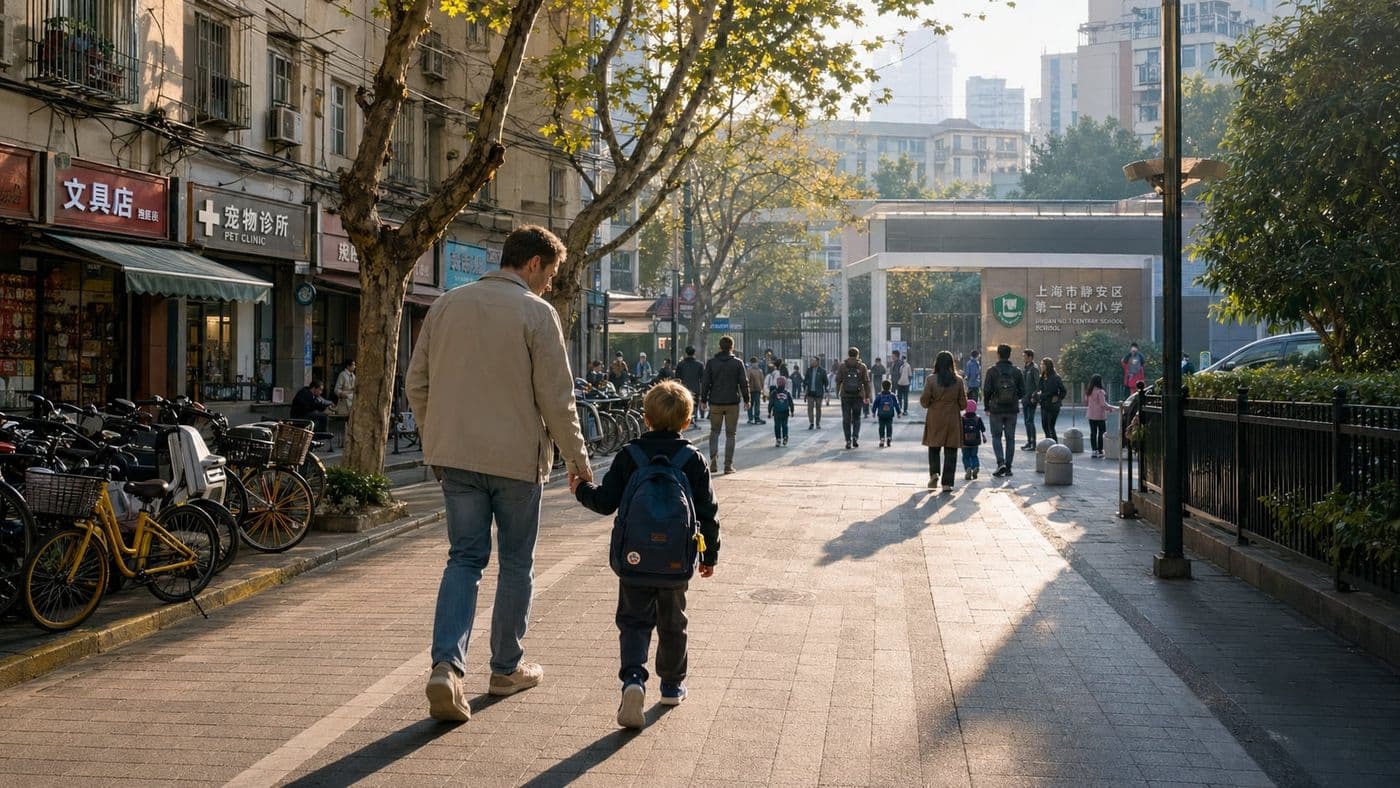
Most families begin with a list of famous schools. In Shanghai, that is often the wrong place to start.
Start with the child’s passport and travel documents. Then look at the parents’ status in Shanghai. Those facts decide which types of school are open to you.
This is not always obvious. SAS, Wellington and SCIS use different category names. Mixed-nationality families may also have more than one passport or travel document in play. The school must review the real documents before it confirms eligibility.
Watch out
Eligible does not mean admitted. Eligibility tells you whether a school may consider the application. The school still decides whether it has space and whether the programme fits the child.
The basic rule, in plain English
China has a legal category called a school for children of foreign personnel: 外籍人员子女学校.
The Ministry of Education rule is short. These schools are mainly for children of foreign nationals who are legally resident in China. As a general rule, they cannot enrol children who are Chinese citizens.
Shanghai also recognises several specific routes for overseas-born children, Hong Kong, Macau and Taiwan families, and a narrow group of Chinese-passport families with overseas permanent residence. These cases need closer review.
That is why a foreign passport is important, but does not always settle the question by itself. The child’s place of birth, China entry document and the parents’ nationality can also matter.
A quick eligibility pre-check
| Family situation | Routes worth checking | What to check first |
|---|---|---|
| Child and at least one working parent hold foreign passports | Foreign-national school; international division; local public or private school | ① Child's passport and China residence document ② Working parent's Shanghai work and residence status ③ The school's own eligibility category |
| Child has a foreign passport; one or both parents hold PRC passports | School-specific foreign-national route; private bilingual school; local school | ① Child's place of birth ② Passport or travel document used to enter China ③ Parents' nationality and Shanghai status ④ Whether the school requires education-authority review |
| Child or working parent is from Hong Kong, Macau or Taiwan | Foreign-national school; international division; local school; Taiwanese school where relevant | ① Mainland Travel Permit or residence card ② Working parent's Shanghai status ③ The school's published category for the family |
| Parents and child hold PRC passports; the whole family has foreign permanent residence | Possible SHMEC exception route; private bilingual school; local school | ① Whole-family permanent residence ② Child's recent study history in that country ③ Intended school's cooperation with the current SHMEC process |
| Child holds only a mainland-Chinese passport and has no applicable exception | Private bilingual school; local public or private school; later international high-school programmes | ① District admission route ② Child's Chinese and academic readiness ③ Current private-school admission rules |
The clearest route: a foreign family working in Shanghai
This is usually the simplest case. The child has a foreign passport. At least one parent works in Shanghai and holds the relevant work and residence documents.
The exact checklist still depends on the school. The current SAS admissions checklist is one example. It asks applicable families to use the online application for passports, residence documents, proof of relationship, proof of residence and employment-related documents.
One item can surprise parents: an employer’s Shanghai business licence. This is not a universal international-school requirement. SAS lists a company-stamped copy in its published government-document checklist. The Shanghai French School also asks for an employment certificate accompanied by the employer’s business licence. If another school does not publish this requirement, do not assume it applies there.
Families applying from overseas may also follow a different timing. SAS, for example, allows certain Shanghai work and residence documents to be supplied after arrival. That is an SAS policy, not a citywide promise.
Mixed-nationality and overseas-born children
This is the area where generic online advice causes the most trouble.
A child may hold a foreign passport while one or both parents hold Chinese passports. The child may also use a Chinese Travel Document or another entry document. Those details can change how the school reviews the case.
Schools organise these cases differently:
- SAS publishes separate categories for overseas-born children of PRC-passport parents, mixed-nationality parents and waiver cases.
- Wellington uses Types A–F.
- SCIS uses Types A, B and C, with several subcategories.
These letters are internal school labels. There is no universal Shanghai “Type A” or “Type B”.
Do not email passport scans to a general inbox just to test your chances. Start with a short written summary: the child’s citizenship, place of birth and China entry document, plus both parents’ citizenship and Shanghai work status. Ask the admissions team which official application route to use. Upload identity documents only through the school’s stated process or another secure channel it provides.
The SHMEC exception route
Some Chinese-passport families may qualify for an exception reviewed by the Shanghai Municipal Education Commission, often referred to as a waiver letter or 教委豁免函.
The official Shanghai criteria are narrow. The whole family must hold foreign permanent residence, and the child must have studied in that country for at least the previous two years. The Shanghai government service page publishes the current criteria and handling procedure.
The intended school normally needs to cooperate with the case. It cannot issue the waiver and should never promise the outcome. SHMEC reviews the application and decides whether to provide the approval.
If this route may apply, contact the intended school through its normal admissions channel. Tell them the family’s actual situation and ask for the school’s current SHMEC procedure. Then follow the official document route the school and authority give you. Do not rely on an agent who says a waiver is guaranteed.
Hong Kong, Macau and Taiwan families
Many foreign-national schools publish a dedicated route for these families. International divisions of Chinese schools may also accept eligible Hong Kong, Macau and Taiwan students.
The paperwork differs from a foreign-passport application. A school may look at a Mainland Travel Permit, residence card or regional identity documents, together with the working parent’s status in Shanghai.
Taiwan families should also look at the Shanghai Taiwanese Children’s School. It follows a Taiwan-oriented system and sits outside the usual English-medium international-school comparison.
“International school” is not one school system
The English label hides several very different choices.
Foreign-national schools
These include schools such as SAS, Concordia, SCIS, Dulwich, Wellington, YCIS and Harrow. They teach international or overseas curricula. Passport and residence eligibility is strict.
Private bilingual schools
A private bilingual school is not simply a fallback for a child who cannot enter a foreign-national school. For many families, it is the more deliberate choice.
The strongest reason is integration. Children spend more time in Chinese. They follow a Chinese curriculum foundation while also gaining exposure to international teaching methods and, in later years, programmes such as IB, A-Level or AP.
This route can suit a family that wants the child to build real Chinese literacy, understand the local education culture and feel less separated from life in Shanghai. Fees are also often lower than at the large foreign-national schools.
The trade-off is workload and variation. The balance between Chinese and English differs greatly by school and grade. Families should look closely at the actual timetable, Chinese expectations and the path into secondary school.
International divisions of Chinese schools
Schools such as SHSID and Jincai operate within Chinese-school structures and publish their own eligibility and assessment rules. They are often more affordable than the large foreign-national schools.
They can also be academically demanding. A strong transcript, subject readiness and the ability to keep up with the programme matter. The English marketing name is not enough; read the current admissions notice for the exact division.
Local public and private schools
Shanghai allows eligible foreign children to apply through local public or private routes. Public-school placement runs through the district, while private-school admission follows the city’s annual rules.
For a child arriving from an English-medium system, the adjustment bar is usually higher in two areas: Chinese and alignment with the local curriculum. Classroom instruction, reading, written work and subject vocabulary can all require stronger Mandarin. Local schools may also expect the child to follow the academic pace of the Chinese programme with less language cushioning.
This can be a strong route for long-term integration. It is not usually the easiest route for a newly arrived child with limited Chinese.
Do not overlook the Japanese, Korean, German and French schools
Shanghai also has schools built around national education systems. They deserve their own category.
- Shanghai Japanese School follows the Japanese system in Japanese. Its 2026 admission rules require Japanese nationality as the standard route, Shanghai residence status and enough Japanese for school life. Elementary tuition is published at RMB 2,500 per month.
- Shanghai Korean School follows the South Korean curriculum in Korean and mainly serves Korean families. Its published tuition is far below the large English-medium international schools.
- German School Shanghai follows the German system through the Abitur. It is a natural fit for a family that expects to return to Germany or continue in German higher education.
- Lycée Français de Shanghai follows the French national curriculum through the Baccalauréat. It accepts more than French nationals and offers structured French support for some non-French-speaking children.
These schools offer continuity with the home-country system. That can make a future return much easier. The Japanese and Korean schools are especially affordable; the German and French schools are also generally below the most expensive English-medium schools, although they are not low-cost schools.
See the Shanghai school fees guide for the current numbers. For eligibility, use each national school’s own language, residence and admissions rules.
After eligibility, the school assesses the child
There is no single “common evidence” list for every Shanghai international school. Each school asks for its own set of materials.
Here are examples that can be sourced:
- SAS asks for the current school-year report and the previous two full years. Depending on grade, it also asks for recommendations, student information and available standardised test results.
- SCIS says it considers academic history, English proficiency and developmental or social-emotional background. A qualified applicant may still enter a wait pool when a grade is full.
- Dulwich states clearly that meeting government eligibility does not guarantee admission.
That is the useful distinction. Documents determine where the family may apply. The school’s academic and capacity review determines whether it offers a place.
A safer way to begin
- Write down the child’s real status. Include citizenship, place of birth, passport and the document used to enter China.
- Write down both parents’ status. Include citizenship, Shanghai work status, residence status and any foreign permanent residence.
- Sort schools by legal type. Foreign-national, private bilingual, Chinese-school international division, local school or national-system school.
- Read the school’s current eligibility page. Do not copy a category from another school.
- If the case is unclear, send a written summary first. Ask which official application route the school wants you to use. Do not attach unrequested identity scans.
- Use the official application channel. Upload documents only when the school tells you what is required and how they should be submitted.
- Then compare curriculum, language, commute and fees. There is little value in touring a school before you know the route is realistic.
Common questions
Shanghai school eligibility: quick answers
Can a mainland-Chinese-passport child attend a Shanghai international school?
Usually not a school licensed for children of foreign personnel. A narrow SHMEC exception route exists for qualifying families with whole-family foreign permanent residence and the child's required overseas study history. Private bilingual and local schools follow different rules.
Does a foreign passport guarantee eligibility?
No. The school may also need to review the child's place of birth and China entry document, the parents' citizenship, and the working parent's status in Shanghai.
Should I email passport scans before applying?
Not unless the school has asked you to use that channel. Start with a short written description of the family's status. Use the school's official portal or secure process for identity documents.
Who decides whether a family receives a waiver letter?
The Shanghai Municipal Education Commission decides. The intended school may need to cooperate with the application, but it cannot issue or guarantee the approval.
Why might a family choose a bilingual school?
It can offer a stronger bridge between Chinese and international education, more meaningful Chinese-language development and lower fees than many foreign-national schools. The academic load and Chinese-English balance vary by school.
Are local public or private schools easier to enter academically?
Not necessarily. For a child coming from an English-medium system, the Chinese-language and curriculum-alignment demands can make the route more challenging.
What is special about the Japanese, Korean, German and French schools?
They preserve a home-country curriculum and teaching language. They are useful for families who want continuity and an easier return to that national system, and several are significantly less expensive than large English-medium international schools.
For the bigger picture, read the full guide to Shanghai school types. Then check when to apply and what the first year actually costs. If housing is also on your list, read why school choice comes before the apartment.
Sources11 referencesChecked July 2026View listClose list
- Ministry of Education rule for schools for children of foreign personnel: jsj.moe.gov.cn
- Shanghai government overview of the three main enrolment routes: english.shanghai.gov.cn
- Shanghai eligibility review and SHMEC handling procedure: zwdt.sh.gov.cn
- Shanghai American School admissions checklist: saschina.org
- Wellington eligibility categories: shanghai.wellingtoncollege.cn
- SCIS admissions guidelines: scis-china.org
- Dulwich eligibility requirements: shanghai-pudong.dulwich.org
- Shanghai Japanese School 2026 admissions: srx2.net.cn
- Shanghai Korean School: skoschool.com
- German School Shanghai admissions: ds-shanghai.de
- Shanghai French School 2026–27 admissions: lyceeshanghai.cn
Policies and document lists can change. Recheck the school’s own admissions page and the relevant Shanghai authority before applying.
Keep reading
- GuideShanghai schools for expat kids: the honest mapThe five kinds of Shanghai school open to expat families, who each can actually enrol, the curricula and where they lead, and how to choose by fit. A 2026 map.→
- GuideWhen to apply to Shanghai international schoolsShanghai 2026–27 admissions timeline: international rounds, public-school dates, bilingual and national-school calendars.→
- GuideShanghai international school fees: the real 2026 billPublished 2026–27 tuition for 25 Shanghai schools, by type — plus the deposits, capital fees, bus and extras that set the real first-year bill.→
helloChina weekly
Get the weekly Shanghai intel
One email a week — visa changes, housing, international schools and culture. Timely, practical, no fluff.