
Why school choice should come before apartment in Shanghai
Author
Lisa Yang
Published
Updated
A relocating family lands at Pudong Airport on a Saturday in March. By the second week, the partner has WhatsApped an agent and lined up six apartment viewings in the Former French Concession. The lane house is gorgeous. The neighborhood walks like a small city. They sign a 12-month lease in April with two months' rent as deposit. ¥35,000 wired up front, before utilities.
In May, the school search begins in earnest. The curriculum they want is at Shanghai American School. SAS Pudong's autumn intake applications closed in February. SAS Puxi is in Minhang — 60 to 90 minutes from the apartment by bus. They look at IB schools instead: SCIS Hongqiao is closer. Round 3 closed on March 20. They look at the British system: Dulwich Puxi is on a Wellington bus route — but Dulwich just announced in April that their fourteen-year-old's Senior School will be moving to Pudong from August 2027.
They've made a sequencing mistake. In the worked ¥25,000/month example below, correcting it creates about ¥25,000–37,500 in likely non-refundable cost, plus moving costs and about ¥25,000 tied up in a normally refundable new deposit.
Watch out
This is the most expensive mistake we see relocating families in Shanghai make.
The hard deadlines you can't see from a Google search
Shanghai's top international schools are not first-come, first-served. They run admissions in rounds, and the rounds close 6–10 months before the school year starts. From the schools' own websites:
- Concordia International School Shanghai (American curriculum, Jinqiao): Round 1 deadline November 10, 2025 for August 2026 entry. (Concordia Admissions)
- SCIS (IB, Hongqiao + Pudong): Three rounds — November 21, January 30, March 20 — and the school states publicly it "operates at or near full capacity in most divisions." (SCIS Admissions Guidelines)
- Shanghai American School: Applications for the August 2026 intake opened September 16, 2025 — almost a full year early. SAS states "seat availability is currently very limited across both campuses." (SAS Admissions)
By the time most relocating families arrive in Shanghai with their leases signed, Round 1 at Concordia has been closed for three months, Round 2 at SCIS has been closed for two, and SAS has been receiving applications for half a year already — adding to a waitlist, not opening new seats.
If you only look at which schools are good in Shanghai without looking at when their applications close, you can be exactly on time and three months too late.
The school you picked may not exist where you assume
In late April 2026, Dulwich College Shanghai — one of the largest international school operators in the city — published an official announcement on its WeChat channel confirming a structural change every relocating family with a teenager should know about. The school's exact words:
“From August 2026, Dulwich College Shanghai Pudong and Dulwich College Shanghai Puxi campuses will unite under a "One College, Two Campuses" model... From the 2027–2028 academic year, all Upper School students (Years 10–13) will be based at the Pudong campus.”
The phased transition, again from the school's own announcement:
- Year 10 + Year 12 (from August 2026): begin IGCSE / IB Diploma at Pudong
- Year 11: complete IGCSE at Puxi, then move to Pudong from August 2027
- Year 13: finish IB Diploma at Pudong and graduate as planned
The Puxi campus continues — but for the K–9 foundational years only.
What this means for a relocating family signing a lease today: if you are bringing a 13- or 14-year-old to Shanghai and you sign a 24-month lease in Minhang or Qingpu on the assumption their Senior School will be at Dulwich Puxi, that assumption no longer holds. Your child's school crosses the river starting August 2027. The lease you signed does not.
This is one school. It will not be the last to do this. International school operators in China face the same financial and demographic pressures as any business. Dulwich Asia, for context, took on roughly $600M of investment from High-ridge Capital and Singapore's GIC in 2024 — that capital eventually wants returns, and returns drive operational decisions.
Note
The takeaway is not that Dulwich made a bad decision. The takeaway is: confirm long-term campus operations directly with admissions, in writing, before signing a 2-year lease. For any school. Not just Dulwich.
The geographic reality nobody quite explains
Shanghai's premier international schools are not in the city center. They cluster in three suburban belts on opposite sides of the Huangpu River:
- Pudong (east of the river): SAS Pudong, Dulwich Pudong, Concordia, Wellington College, NAIS Pudong, SCIS Pudong
- Puxi suburban (Minhang + Qingpu, west): SAS Puxi, Dulwich Puxi, BISS Puxi, WISS, SSIS
- Hongqiao / Gubei (Puxi inner-west, the established Korean and Japanese expat zone): SCIS Hongqiao, YK Pao, Livingston, YCIS Puxi
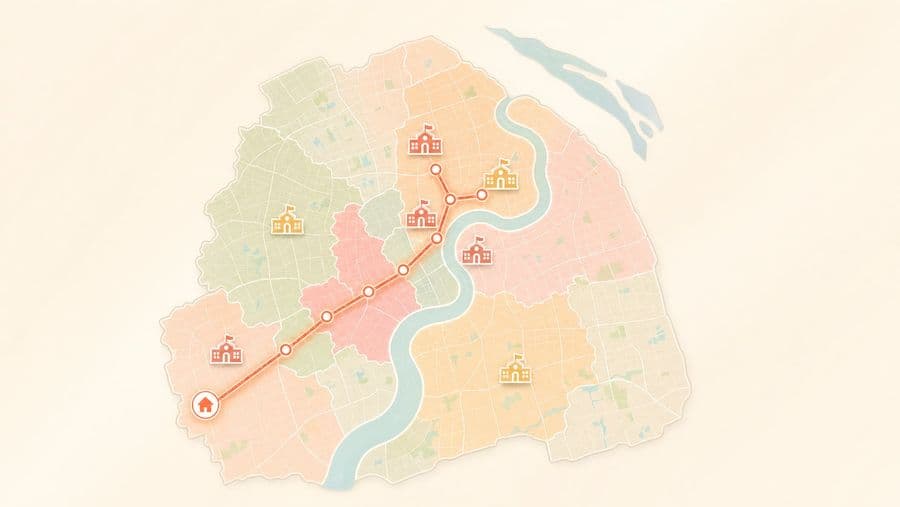
You can read the geography from how the schools manage transport. Wellington College publishes 130 pickup points in Puxi and 70 in Pudong for its school bus — a tacit admission that families live everywhere, and the school is doing the cross-bridge work because the family-side commute is intolerable. The Good Schools Guide notes that "families with older kids tend to polarize to either side of the city closer to the international schools" — that is, the right move is school-then-neighborhood, not the other way around.
That geography is why which Shanghai neighbourhoods expat families actually cluster in follows from the school, not the other way around — school first, then the area, then the apartment.
A family that takes a Former French Concession lease (Puxi center, walkable, beautiful) and ends up at SAS Pudong has put their child on the bridge twice a day, every school day, for the next 1–3 years. Or paid to break the lease.
The lease math, when it goes wrong
Most current Shanghai residential leases run for 12 months. Common payment structures are 押一付一 or 押一付三: one month's deposit plus one or three months' rent paid in advance. At ¥10,000 a month, that means ¥20,000–40,000 before any agency fee or utilities.
Most standard Shanghai residential leases we see use a one-month deposit. If the tenant leaves early without an agreed break clause, the usual practical outcome is that the landlord keeps that deposit. The contract controls the exact liability: Article 585 of China's Civil Code allows the parties to agree liquidated damages and allows a court or arbitration tribunal to adjust an amount that is materially out of line with the actual loss. Read the early-termination clause and negotiate any exit in writing.
Worked example — family of four on a ¥25,000/month three-bedroom in Jinqiao that turns out to be on the wrong side of the river:
- One-month deposit retained by the current landlord: ~¥25,000
- Agent fee on the replacement apartment: ¥0–12,500, depending on the channel and agreement
- Deposit on the replacement apartment: ~¥25,000 tied up in cash, but normally refundable rather than a loss
Important
Likely non-refundable cost of correcting the mistake: ~¥25,000–37,500 — before moving costs or any additional amount required by the signed lease. Separately, allow about ¥25,000 of refundable cash for the new deposit.
A note about lane houses, while we're here
The French Concession's lane houses (老洋房 / 石库门) are beautiful but old. Pre-war housing stock has well-documented issues with humidity, plumbing, electrical systems, and pests — termites in particular thrive in Shanghai's warm, humid spring. Some agents mask structural and pest damage with cosmetic renovation before listing.
If you fall in love with a lane house: insist on an independent pest inspection before signing, especially in the April–June window. Negotiate a clause that allows penalty-free termination if active infestation is found post-move-in. Whether the landlord agrees is a separate matter — but a tenant can ask, and the asking itself screens for a landlord who has something to hide.
Why families still get this wrong
Four structural reasons, none of them stupid:
- Apartments are concrete; schools are abstract. Listings have photos, prices, room counts. School admissions involve waitlists you can't see, application rounds in another language, and age cutoffs that vary by curriculum.
- Corporate relocation packages default to housing-first. "Home viewings, school searches, city orientation" — listed in that order. The package allocates housing budget; school choice is "left to the family."
- Most foreign-passport international schools use English as the default admissions language; French, German, Japanese and Korean schools use their own working languages. Chinese-first systems are more common in private bilingual and local-school routes. The real asymmetry is immediacy: apartment listings feel concrete today, while school consequences arrive later.
- Trailing spouse needs a place to live now. Schools "can wait." Schools cannot wait.
The right sequence
“School first. Then neighborhood. Then commute. Then apartment. Visa anchors the timeline.”
This is the order things hold together in. School choice has the longest application window, the most rigid intake structure, and the deepest second-order effects on family rhythm. It needs to anchor the rest. Start with the official-source map of Shanghai school types, then check eligibility, admissions timing and fees before setting the housing search area.
If you've already signed the lease — read this last
If the apartment is signed and the school search has just started: don't break the lease in panic. Expensive mistakes happen twice — once forward, once backward.
Three things buy you time:
- Bus routes. Wellington's 130+70 pickup-point map is not unique. Most international schools run bus networks that absorb 60- to 90-minute one-way commutes. Painful but survivable for one academic year while you reset.
- Serviced apartments for the first 60–90 days, with a 30-day notice period instead of a 12-month lease. More expensive per night, drastically cheaper if you have to move.
- Diplomatic clauses in the lease. Pre-negotiated, not standard. If you're still in lease negotiation: ask for a clause that allows penalty-free termination if your child's school placement requires a relocation. Landlords resist, but some accept for white-collar foreign tenants.
What helloChina does
The reason this post exists is that we get this exact phone call over and over: family arrived 60 days ago, lease is signed, the school they want is across the river or has a closed waitlist, the Pudong-Puxi consolidation just changed the math on a school they were betting on.
The fix is to do it in the right order. We sequence the move so you don't resequence it later — school fit first, then neighborhood, then apartment, with visa timing wrapping the schedule.
Use the complete map of Shanghai school types to understand the routes, then check eligibility, the 2026–27 admissions timeline and the real first-year fees.
Keep reading
- GuideShanghai schools for expat kids: the honest mapThe five kinds of Shanghai school open to expat families, who each can actually enrol, the curricula and where they lead, and how to choose by fit. A 2026 map.
- GuideWho can attend a Shanghai international school?A clear guide to Shanghai school eligibility for foreign, Chinese, mixed-nationality, Hong Kong, Macau and Taiwan families.
- GuideWhen to apply to Shanghai international schoolsShanghai 2026–27 admissions timeline: international rounds, public-school dates, bilingual and national-school calendars.
helloChina weekly
Get the weekly Shanghai intel
One email a week — visa changes, housing, international schools and culture. Timely, practical, no fluff.